Environmental Education and Struggling Schools

How do effective environmental programs relate to student achievement?
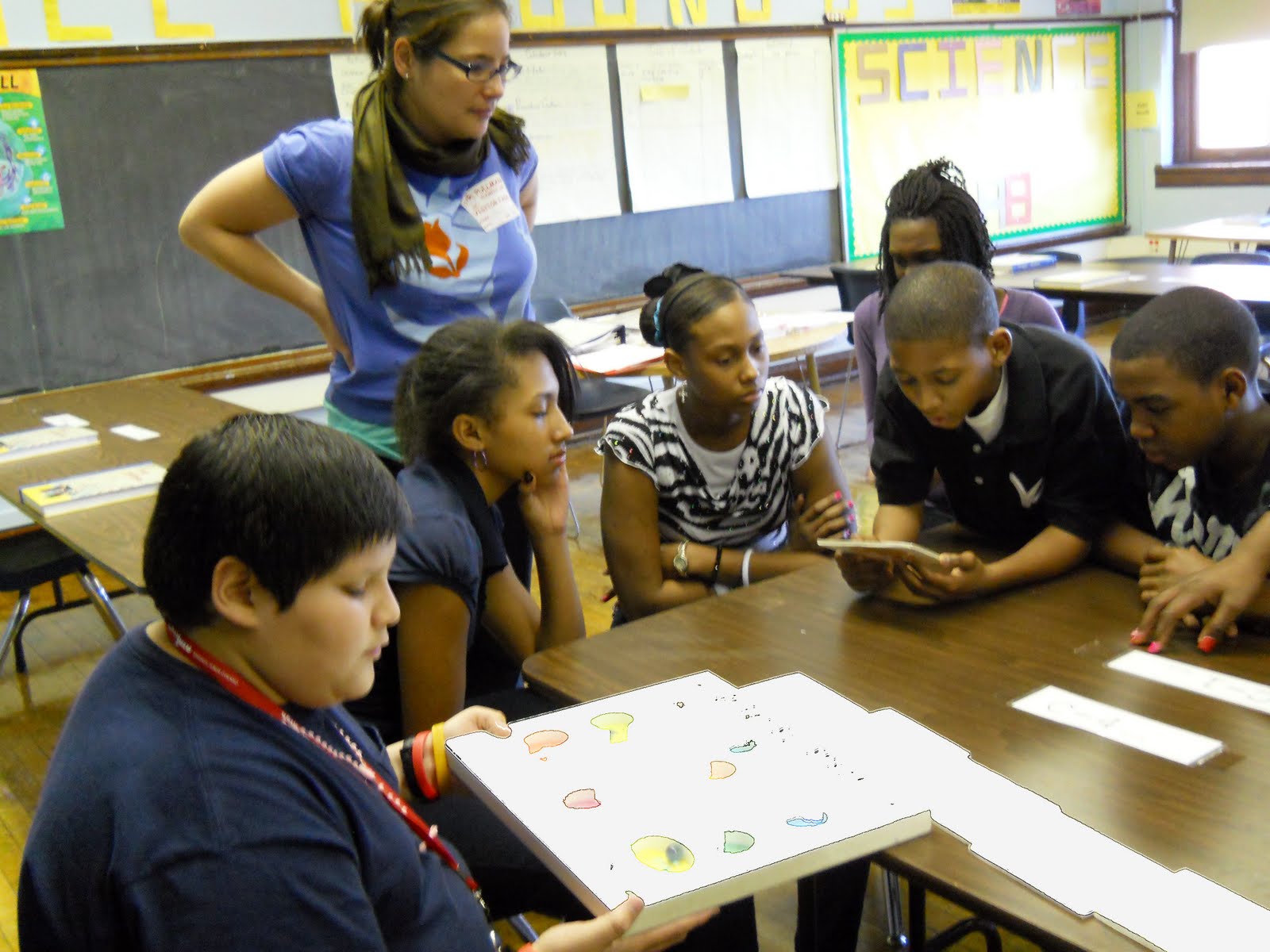
Seventh and eighth graders in CEEP’s Earth Force program choose a local environmental issue to study and develop a project to address it. Photo courtesy of Lakeside Views.

Seventh and eighth graders in CEEP’s Earth Force program choose a local environmental issue to study and develop a project to address it. Photo courtesy of Lakeside Views.

In the Calumet Region along the southern shores of Lake Michigan, the Chicago Field Museum serves over 2,700 students in grades four through twelve with its Calumet Environmental Education Program (CEEP). Fourth through sixth graders learn about biodiversity through field trips to local nature and stewardship activities; middle school students identify local environmental issues and develop action projects around them; high schoolers participate in ecological monitoring, attend leadership days, and work at summer internships.

“Growing up and learning through the Calumet Environmental Education Program…shaped the path my life would follow,” Purdue University sophomore Sophia Vela wrote for the Field Museum’s website. Vela is majoring in Natural Resources and Environmental Science at Purdue’s College of Agriculture.

CEEP makes use of the rich ecological resources in the Calumet Region to teach students about conservation and biodiversity. But just north of the Calumet Region, the Chicago public school system, like urban school systems all over the US, struggles with funding issues, school closings, and race and socioeconomic achievement gaps.
Continue reading

Against the Wind-or With it?

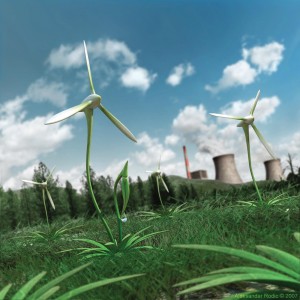
green grass turbinesWind is a natural phenomenon that occurs when molecules move freely in response to differences in air pressure. Likewise, energy can be harnessed for human consumption when blades of a turbine move in response to these innate fluctuations. Wind farming allows for the production of relatively clean energy. The price of this energy, however, is far from free.


Continue reading

Extreme Makeover: Home Energy Edition

Home energy audits are an excellent way to ensure that homes are saving as much energy as possible. Poor insulation is often a major cause of energy leakage and high energy bills. Photo courtesy of the Better Business Bureau - Flicker.

Home energy audits are an excellent way to ensure that homes are saving as much energy as possible. Poor insulation is often a major cause of energy leakage and high energy bills.
Photo courtesy of the Better Business Bureau – Flicker.

The energy industry is simultaneously one of the most environmentally damaging and economically costly sectors in the United States. That being said, great potential exists to improve the industry by investing properly in efficient technologies while reducing energy demand, which all begins in the home.

Residential activities play a tremendous role in national energy usage and greenhouse gas emissions. According to the EPA, the 128 million residential buildings in the United States are responsible for 21 percent of national carbon dioxide emissions. These buildings account for 20 percent of total energy consumption in the nation, as well as nearly 50 percent of total electricity consumption. Americans together spend $230 billion each year on energy in the home; the average household spends at least $2,000 a year on energy bills, over half of which goes to heating and cooling costs.

If the United States hopes to significantly mitigate its electricity and energy usage, thereby decreasing greenhouse gas emissions, a great deal of attention must be paid towards residential homes. As an added incentive, when homeowners choose to increase the energy efficiency of their homes, they not only are they doing something good for the environment, but they are also creating great monetary savings for themselves. A combination of public policy and individual household action is needed to successfully reduce the amount of energy that is currently being inefficiently used by America’s homeowners.  Continue reading

The Truth about Travel: The Benefits of Ecotourism

Cruise Ship. Photo courtesy of Colin Delaney

Travelers take cruises to exotic places where they don’t necessarily get an authentic experience. Photo courtesy of Colin Delaney/ Flickr Creative Commons

With the arrival of spring comes the exodus of college students from their stressful, dreary campuses to the soft, sandy beaches of the tropics. Most travel to places like Mexico and the Dominican Republic where they can lounge in the sun and forget about their schoolwork. However, though they are traveling to exotic places with interesting cultures, they are not necessarily authentically interacting with the people they meet and the places they see.

A group of students from Barnard College in Manhattan went on a cruise for their spring break which stopped in Mexico and Jamaica. After their trip, they found their experiences to be very inauthentic. Emily Kawai, a senior at Barnard, said that while in Jamaica, her tour guide and the locals “hyped up the stereotypes for the tourists.” She observed that many people were wearing the Rastafarian colors and saying quotes from Bob Marley. “They wanted to give the tourists what they expected,” she says. Gaby Ittah, also a senior at Barnard, agreed with Emily, saying that “the ports milk the tourism industry.”

Ecotourism, on the other hand, strives to create a cohesive travel experience that includes the community in an authentic way. Ecotourism encourages sustainable tourism and as a result, businesses involved in ecotourism put a lot of emphasis on community building and outreach within the communities that they are operating.

Continue reading

China’s Economic Miracle and Environmental Hope

In terms of scale and speed, China’s economic transformation has no historical precedent: since initiating market reforms in 1978 China has shifted from a centrally planned economy to a market based one. In 1978 China was one of the poorest country’s in the world with its GDP only one-fortieth of America’s and only 16% of its population living above the poverty line. Since then it has demonstrated a stunning economic reversal which many deem as the “Chinese economic miracle”: while in 1978 only 16% of its population lived above the poverty line, by 2005 only 16% lived below it; while in 1978 its GDP was only one-fortieth of America’s, with an astounding rate of 8% real per capita GDP growth annually, China’s GDP is now almost one-fifth of the U.S. level.  This rapid and sustained improvement in average living standard has occurred in a country with more than 20 percent of the world’s population (population of 1.3 billion people), thus causing China to be the world’s second-largest economy as well as lifting 500 million people out of poverty.

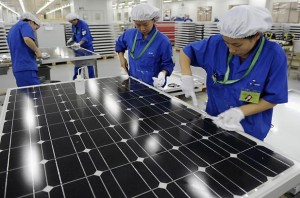
Photo courtesy of econews.com. Chinese workers manufacturing solar panels.

Photo courtesy of econews.com. Chinese workers manufacturing solar panels.

However, all industrial nations one day hit an environmental turning point, an event that galvanizes the population to realize the ecological consequences of rapid growth. In America in 1969, that event occurred when the Cuyahoga river in Ohio, thick with pollutants, caught fire. America’s Environmental Protection Agency was founded the next year. The rank smog in Beijing could join the ranks of these environmental turning points. A swathe of warm air has settled over the Chinese capital like a duvet and trapped beneath it pollution from the region’s 200 coal-fired power plants. The concentration of pollutant particles hit 900 parts per million—40 times the level the World Health Organization deems safe.

Continue reading